SYSTEMS WITHIN SYSTEMS COLLAPSING SYSTEMS1
— Laura Benítez
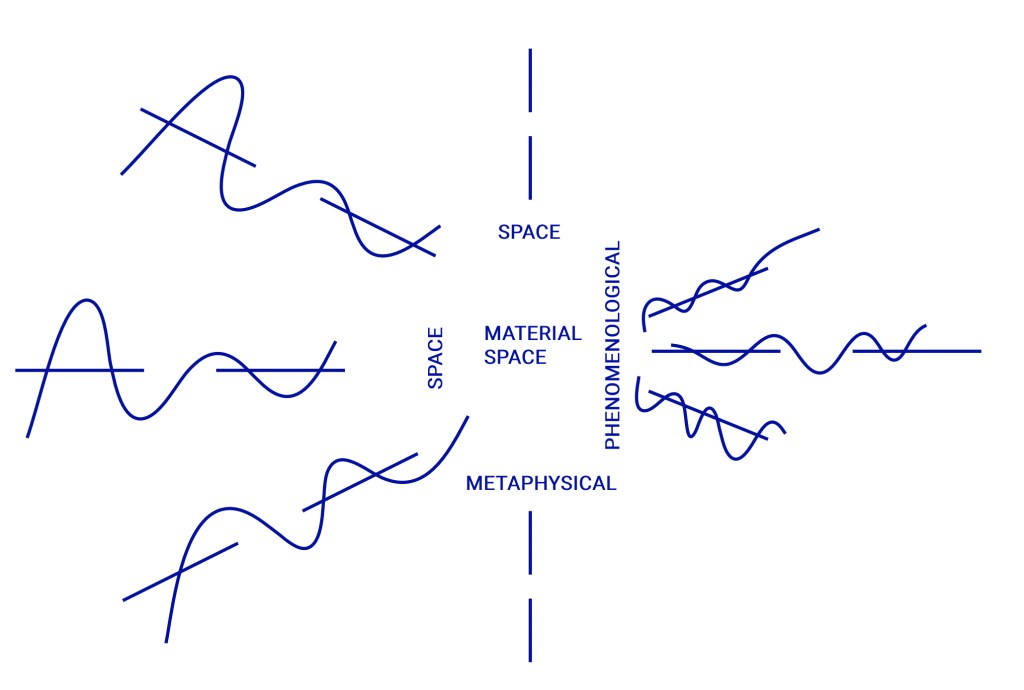
2
ETYMOLOGYCAL CLUES3 OF DISTRACTION
DISTRACCIÓN (distracció in Catalan) From the Latin distractio, distractionis (“separation, division into multiple ways, disunity”), action name of the verb distrahere (“to pull in opposite or divergent directions”). Distrahere is composed of dis- (“separation by multiple ways, divergence”) and the verb trahere (“to drag, pull”).
SYSTEM From the Latin systema, and this, from the Greek συστεμή (systema = “union of things in an organized way”), composed of συν (syn = “together”, as used in synagogue or idiosyncrasy), ιστημι (hístemi= “to establish, to straighten, to stay straight”) and the suffix -μα, which indicates instrumental-means-result, as used in axiom, lexeme, morpheme.
NADA4: comes from the Latin nata, the “feminine” form of the participle natus, -a, -um (“born, originated”), from the Latin nasci (“to be born”). To understand its strange semantic evolution, it is necessary to know that the Spanish nada comes from unnata included in the Latin expression res nata, idiotism from vulgar latin widely used since Plautus, in the 3rd century BC, which meant “the matter in question”, “the circumstance produced that occupies us”. Thus, we see expressions such as, in Cicero, pro re nata (“given the state of circumstances”) or, in Terence, ere nata (“from the state of things”). The evolution of this expression to a negative meaning in Spanish occurs by analogy with nati, the participle in the masculine plural. This was also included in an expression, homines nati (“the born men”), which was frequently used with the value of “the human race” or, if you like, “all”. Curiously, this nati, which originally gave nadi, in Spanish ends up meaning the opposite: nadie. The inclusion of this expression in negative sentences in Latin —of the type homines nati non fecerunt (“the human race did not do it” = “everyone did not do it” = “no one did it”), homines nati numquam viderunt (“the human race never saw it” = “everyone never saw it” = “no one saw it”), etc.— seems to be what makes this participle assume a negative value that replaces nemo (“nobody”, “nobody” in Spanish) at the end. At the same time, it is considered that the expression res nata, by analogy, goes from meaning “the matter in question” to “no matter in question” (that is, “nothing” in Spanish), and replaces the form of the indefinite Latin nihil.
OMNIA ME DISTRAHUNT, NIHIL IN ME CONFERO OMNIA ME DISTRAHUNT, NIHIL INTENDUNT IN NIHIL, NULA OUSÍA
DISTR/ACTION SYSTEMS
The proposal for distr_active listening(s) escapes attempts at mere interpretation of the world, starting from a listening through which other material and temporal events are configured. That which may or may not happen. With his distraction patterns, Arnau Sala proposes a displacement, perhaps without intending it, of what has been understood as deep listening, mainly linked to figures such as Pauline Oliveros. A highly demanded practice, almost sacralized, by those who, replicating the transcendental order and the cult of adoration to the emphasis of the self, 5 define themselves as experts in sound art, categorizing sacred rituals, compositions of Truth.
The true world, accessible to the wise, the pious, the virtuous, —he lives in that world, it is that world. (The oldest form of the Idea, relatively intelligent, simple, convincing. Transcription of the thesis “I, Plato, am the truth”.)
(I, expert in sound art, am the truth.)6
The problem, if there were one, is not in Pauline Oliveros’ proposal, per se. The mention of deep listening is presented here as an introduction to a particular and situated practice that, unlike many others, does not possess a witness to truth. A differentiated practice that operates in a kind of temporal limbo, the one of the maybe. Which instead of situating itself in certain aspirations of some certain transcendental state through rituals of deep listening, it poses an awakening to everyday life. A constitutive uncertainty which is-being-here-between artistic practices and philosophy. This distracted listening(s) [de]centers emptiness,7 generating planes of in-difference in which a horizon of possibility opens up to free oneself from the emphasis 8 on the self. Reversing or inverting the ascetic figure of the expert, who sacralizes deep and attentive listening, for that of the artist-philosopher;9 embodying the Nietzschean promise of a productive friendship between art and philosophy; leaping into a void that empties the listener into what is listened to. A friendly indifference that articulates reciprocal understandings that, without denying the particular, contribute to dissolving substantial rigidity. A distracted listening(s) that are a radical turn to the here. A dispersed practice of being_with.
THE NO-LONGER [IS] CONSTITUTIVE (OF THE WORLD)

This is (no longer) a circle.

It is a polygon, with 192 sides and 192 corners.

Method to calculate the area of a circle.
These [no longer] circles which are polygons illustrate Liu Hui’s π algorithm, a mathematician from the Cao Wei kingdom in the 3rd century, to calculate the values of π by calculating the perimeters of polygons. Generating systems within systems. As did Zu Chongzhi, a mathematician and astronomer from the 5th century, who used the rod calculus, a mechanical system of calculation based on rods, for his operations.

Rod calculus
Both Liu Hui and Zu Chongzhi stood out because, among other issues, they considered that it is not necessary to create a method to calculate an exact approximation to π at first. Stressing that what is needed is the generation of a method which can get close to it and that, therefore, can be repeated [process] as many times as desired, until the result is as precise as desired. A procedural repetition very similar [metaphorical scope] to the mantras, meditations and protocols of distraction that articulate those other listenings of everyday life. A distracted rod calculus that brings us closer to a subversive π than to a samadhi. To a π that overflows. To a practice(s) of distracted_dist(r)_active listening(s) that make it difficult to sustain a conception of exclusive subjectivity, as well as any conception of a fixed, permanent and lasting self, that constitutive self of the world. [F -| EgL Ont].10
Distracted listening, more dispersed than gathered, disinteriorizes the space, and turns it into a kind of open house. In a system within systems that overflow systems.11
1 Given the unique nature of the text (originally written in Spanish), all words used metalinguistically have been maintained in Spanish to guarantee the overall meaning of the dissertation. (Ed.’s note)
2 Three spaces or systems within systems that do not have clear, concrete delimitations. The delimitations only function as an attempt at a temporary and metaphorical representation of the thing.
3 Etymological definitions of words in Spanish from the Diccionario etimológico castellano enlínea: http://etimologias.dechile.net/. Some quotation marks have been added to highlight problematic and ironic issues.
Etymological (etymological in Catalan): word formed with Greek roots, meaning “relating to the true origin of words”. Its lexical components are etymos (“true”) and logos (“word, study, treatise”), plus the suffix -ikos (“relating to”).
4 Nada in Spanish means both nothing and void. Res in Catalan means nothing, but if you add no-res, it also means void.
5 Perhaps because they only listen “deeply” to themselves.
6 “How the True World Became a Fable. The Story of an Error”, Twilight of the Idols (1888). In this fragment, along with five other points, Nietzsche presents a critique of classical metaphysics through the figure of Plato. For Nietzsche, Socrates begins what he will call “the decadence of European culture”, by putting life at the service of knowledge, when, from his perspective, it should be the opposite: knowledge at the service of life. At this point, the critique of Plato refers to the world of ideas, since Nietzsche accuses Plato of giving more importance to a world “beyond” and not to the empirical world in which we find ourselves, where life happens. According to Nietzsche, by doing this, Plato denies life; for this reason he strongly criticizes this “tendency” of Western philosophy to look for an element that transcends the (empirical) world, an “element” outside the world that orders and gives meaning to the world (world of ideas, substantial power, God…). Therefore, this fragment shows, among other issues, a critique of the transcendental order and the possession of Truth. The Nietzschean proposal seeks to affirm life, not deny it.
7 It refers to emptiness (sûnyatâ) in Zen Buddhism, which differs from the concept of substance (ousia) in the Western tradition.
8 Of the emphasis on the self, not of the self itself.
9 It is proposed to move from the text to the practice, not that the practice (or those who practice it) seek to define themselves as such.
10 On the fakeness of the formula.
Meaning: non-egological phenomena that open up what is ontological
11 This text is not a descriptive system, it is a game of clues that makes it impossible to concentrate on use as an interpretation of a practice from the imposition of processes of meaning through the written word.
 ⬤
⬤ 